
Niche edits have quietly become one of the most powerful link-building tactics available to SEOs in 2026, yet most website owners still have never heard the term. If you have spent weeks chasing guest post placements only to wait even longer for a single backlink to go live, niche edits offer a faster, and often more trustworthy, alternative.
This guide breaks down exactly what niche edits are, why they work so well for search rankings, and how to start using them without wasting your budget on the wrong pages.
What Are Niche Edits?
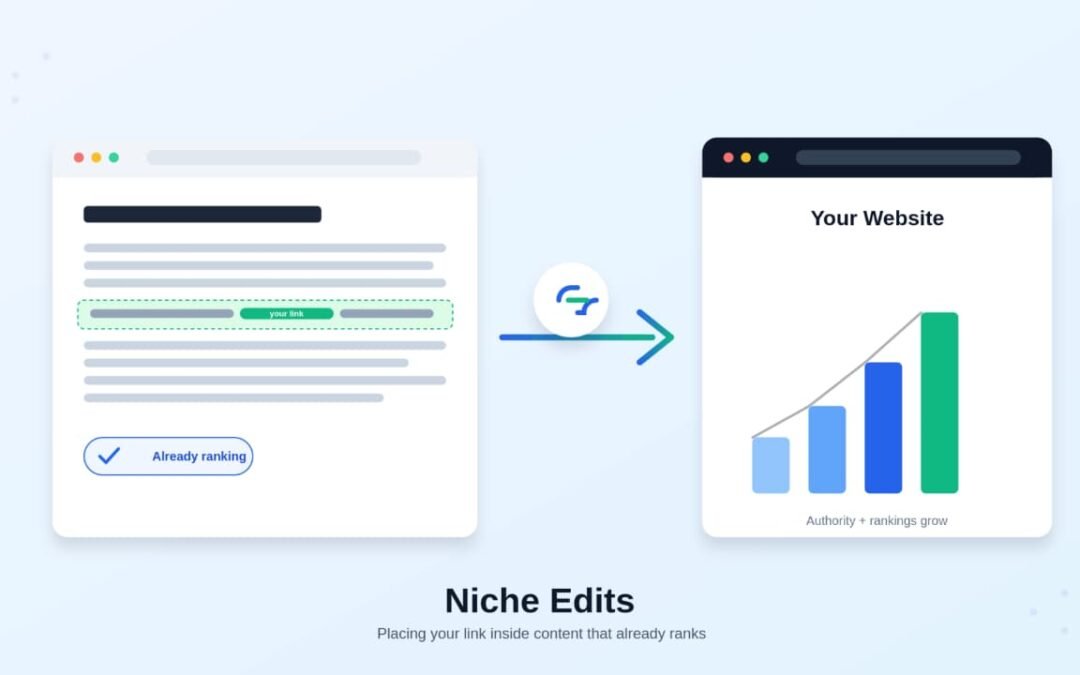
A niche edit, sometimes called a curated link, is the practice of adding your link inside an already-published, relevant article on someone else’s website. Instead of writing brand-new content the way you would for a guest post, your SEO team finds an existing page that already ranks and carries topical relevance, then inserts a link to your site naturally into that content.
Because the host page is already indexed, already trusted by Google, and already receiving traffic, a well-placed niche edit can pass authority to your site far faster than waiting for a brand-new guest post to earn the same trust from scratch.
Why Niche Edits Work So Well for SEO
There are three main reasons niche edits consistently outperform other link-building tactics:
- Speed: the host page is already aged and indexed, so there is no waiting period for a brand-new article to build its own credibility first.
- Inherited trust: your link sits inside content that has already earned rankings, backlinks, and reader engagement of its own.
- Natural signals: because the surrounding content was not written to sell a link, niche edits tend to look and read more organically to both users and search engines.
Niche Edits vs. Guest Posts: What Is the Difference?
Guest posts require writing an entirely new article for a publisher, which takes time and depends on that new page eventually earning its own authority. Niche edits skip that step entirely by placing your link inside content that has already proven itself. Most experienced link builders use a mix of both, but niche edits are typically the quicker win when you need results in the current quarter rather than next year.
How to Get Started With Niche Edits
- Identify the exact keywords and pages on your site you want to boost.
- Use a backlink tool to find relevant, already-ranking articles on topically related sites.
- Reach out to the site owner and propose a natural, useful addition to their existing article.
- Negotiate placement and confirm the link will stay live long-term.
- Track the result in Google Search Console and your backlink monitoring tool.
If manual outreach for niche edits sounds like more than your team has time for, our link-building services team handles sourcing, outreach, and placement for you.
Common Mistakes to Avoid With Niche Edits
The most common mistake is prioritizing a site’s overall traffic over topical relevance—a link from an unrelated industry rarely helps as much as a smaller but closely related site. Other frequent errors include using the same exact-match anchor text on every placement, skipping a toxic-link check before buying access to a page, and forgetting to confirm that a link will actually stay live rather than being removed once payment clears.
Are Niche Edits Safe for Google Rankings?
Niche edits carry a reputation problem more than a real risk problem. Because some sellers stuff irrelevant links into old articles purely for profit, Google has gotten better at spotting low-quality patterns. But a niche edit placed on a genuinely relevant page, surrounded by natural anchor text, and left in place long-term behaves exactly like any other earned editorial link. The risk comes from volume and relevance, not from the tactic itself—ten well-placed niche edits on closely related sites will always outperform a hundred random ones on unrelated blogs.
A simple rule of thumb: if you would be comfortable explaining the placement to Google in plain language, it is almost certainly safe. If the only justification is that the host site has high traffic, that is a sign to look elsewhere.
Final Thoughts on Niche Edits
Niche edits are not a shortcut around good SEO—they are a faster route to the same destination: relevant, trusted links pointing at pages you actually want to rank. Used carefully, with attention to relevance and anchor-text variety, niche edits can meaningfully speed up how quickly your site earns visibility in 2026 and beyond.